Raspberry pi family
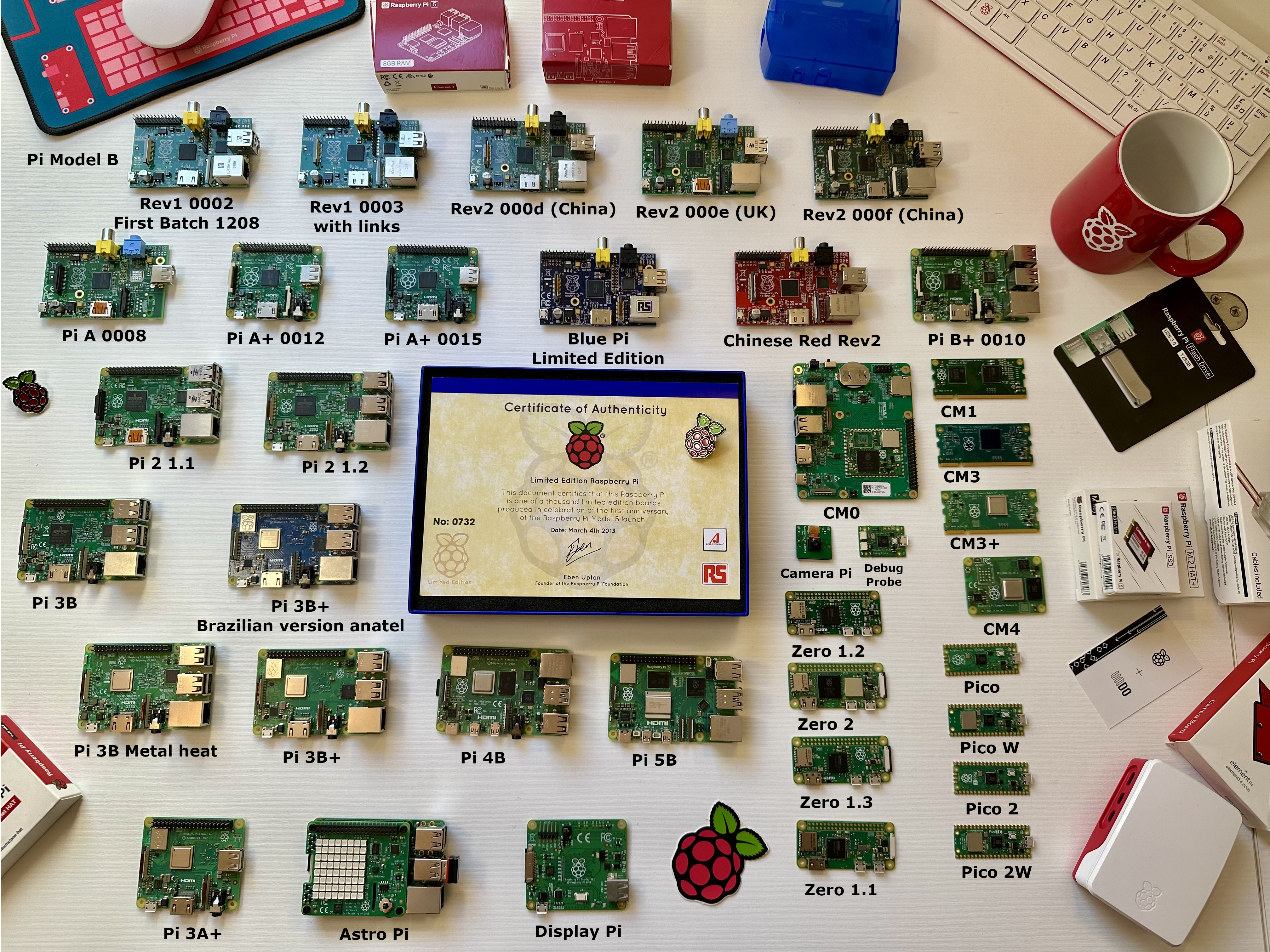
Across various projects, I am somewhat surprised by the diverse array of boards I have collected. Here’s the family photo. You can click it for a higher resolution version.
Rev 1 Model B
In row 1, column 1 is the Rev 1 Model B, one of the first 10,000 units produced and launched on February 29, 2012. As the original Raspberry Pi model to hit the market, it features 256 MB of RAM and USB polyfuses.
Rev 1 Model B – With Links
In row 1, column 2 you’ll see a slightly later variant of Rev 1 model B. This one has 0 Ohm links instead of polyfuses. It helped to overcome some of the voltage drop issues associated with the original Rev 1, but it introduced the “hot-swapping USB devices will now reboot your Pi” issue, which was fixed in the B+.
Chinese Red Pi Rev 2 Model B
This is one of the Red Pis made especially for the Chinese market. They are not allowed to be sold in the UK, but if you import one yourself that’s not a problem. It is manufactured to a less stringent spec than the ones at SONY, and is not EMC tested. Therefore it bears no CE/FCC marks.
Model B+
Row 3, column 6 is the model B+. This was launched on 14 July 2014 and was a major change in form factor. Rounded corners, corner mount holes, 40 GPIO pins, 4 USB ports, improved power circuitry and a complete layout redesign. The B+ was announced as the final revision of the B.
Limited Edition Blue Pi Rev 2 Model B
RS had 1000 of these made in March 2013 as a special limited anniversary edition to use as prizes and awards to people who’ve made a special contribution to education etc. They come in a presentation box with a certificate. Other than their blueness, they are a Rev 2 model B Pi.
Model A
Row 2, Column 1 is a model A. The PCB is identical to the Rev 2 model B, but it has only one USB port, no ethernet port, no USB/ethernet chip and 256 Mb RAM. The $25 model A was released in February 2013. The model A sold about 100k units. Demand for it was outstripped by the model B.
Model A+
In row 4, all by itself we have the shiny new Raspberry Pi A+, launched 10 November 2014. It’s essentially the same as a B+ with the USB end cut off. It’s the smallest, lightest, cheapest, and least power-hungry Pi of all so far. It’s 23g, $20 and uses just half a Watt at idle.
Raspberry pi 2
The Raspberry Pi 2 Model B is the second-generation Raspberry Pi. It replaced Raspberry Pi 1 Model B+ in February 2015. The main specifications of this minicomputer include a quad-core ARM Cortex-A7 processor clocked at 900 MHz and 1 GB of RAM.
- Revision 1.1 : Broadcom BCM2836 Quad-core ARM Cortex-A7 (32-bit, ARMv7)
- Revision 1.2 : Broadcom BCM2837 Quad-core ARM Cortex-A53 (64-bit, ARMv8)
The v1.2 revision uses the same BCM2837 processor found in the Raspberry Pi 3 Model B, but underclocked to 900 MHz to maintain power consumption and thermal performance similar to the v1.1. This shift gave the board a 64-bit capable CPU. Although Revision 1.2 shares the Pi 3's main chip, it does not include the wireless or Bluetooth modules featured on the Pi 3.
Raspberry pi 3
The Raspberry Pi 3 family consists of three distinct models: the original 3 Model B (2016), the upgraded 3 Model B+ (2018), and the compact 3 Model A+ (2018).
The Pi model B use a Broadcom BCM2837 Quad-core ARM Cortex-A53 (64-bit, ARMv8) @ 1.2 GHz. The B+ and A+ utilize the BCM2837B0 chip, which features a metal heat-spreader. This improves thermal management and boosts CPU speed from 1.2 GHz to 1.4 GHz without overheating as easily.
Compute Module 1, 2 & 3
This was launched 23 June 2014 as a way to enable industrial use of the Pi in a more convenient form factor. The module is made so it fits in a SODIMM connector and is essentially the BCM 2835, its 512 Mb RAM and 4 Gb of eMMC flash memory with all available GPIO ports broken out.
Raspberry Pi Compute Module Zero (CM0)
The Raspberry Pi Compute Module Zero (CM0) is an ultra-compact System on Module (SoM) engineered for embedded and industrial integration. Built on the core architecture of the Raspberry Pi Zero 2 W and initially tailored for the Chinese market, the goal is to provide a cheap alternative of compute module. The processor is Broadcom RP3A0 who is consisting of a Broadcom BCM2710A1, which is the silicon die packaged inside the Broadcom BCM2837 chip quad-core 64-bit Arm Cortex-A53 processor (1.0 GHz) which is used on the Raspberry Pi 3, along with 512 MB of DRAM.
The CM0 exposes raw interfaces around its perimeter, enabling direct soldering or mounting onto custom carrier boards.
Fun fact: despite its lower model number, the CM0 was released after the original Compute Module 1 (CM1).
Sense Hat
Raspberry Pi Sense HAT sits on top of the Raspberry Pi computer and includes a range of sensors, such as a gyroscope and temperature sensor.
https://astro-pi.org/